Federal Reserve Interest Rates 2025: Investment Impact

The Federal Reserve’s interest rate decisions will profoundly influence investment strategies in 2025, affecting everything from market valuations to borrowing costs and requiring investors to adapt their portfolios to new economic realities.
As we navigate the complexities of the global economy, the decisions made by the Federal Reserve hold immense sway over financial markets and individual portfolios. Understanding the Federal Reserve’s latest interest rate decisions is not just for economists; it’s crucial for every investor planning for 2025. These policy shifts determine the cost of borrowing, the attractiveness of savings, and ultimately, the trajectory of various asset classes. This article explores the recent updates, their potential financial impact, and what they mean for your investment strategy in the coming year.
Understanding the Federal Reserve’s Mandate and Tools
The Federal Reserve, often referred to as the Fed, serves as the central bank of the United States. Its primary mandate is to foster maximum employment, stable prices, and moderate long-term interest rates. To achieve these goals, the Fed employs several powerful monetary policy tools, with interest rate adjustments being among the most impactful.
When the Fed alters the federal funds rate, it influences a cascade of other interest rates throughout the economy. This benchmark rate affects everything from consumer loans and mortgages to corporate borrowing costs, thereby impacting economic activity and inflation. Investors must grasp this fundamental mechanism to anticipate market reactions.
Key Monetary Policy Instruments
- Federal Funds Rate: This is the target rate for overnight lending between banks, directly influencing short-term interest rates.
- Quantitative Easing (QE) and Tightening (QT): These involve buying or selling government securities to inject or withdraw liquidity from the financial system.
- Discount Rate: The interest rate at which commercial banks can borrow directly from the Federal Reserve.
- Reserve Requirements: The amount of funds banks must hold in reserve against deposits, though this tool is used less frequently now.
These tools are not used in isolation but are part of a coordinated strategy to steer the economy. The Fed’s communication regarding its future intentions, often called forward guidance, is also a critical component, influencing market expectations even before concrete actions are taken. Understanding this framework is the first step in deciphering the broader financial implications of their decisions.
In essence, the Federal Reserve’s actions are designed to manage economic growth and inflation. By adjusting interest rates, they aim to either stimulate spending and investment during downturns or cool down an overheating economy. These interventions are subject to constant review and adaptation based on incoming economic data and global conditions, making their decisions a dynamic factor in any investment outlook.
Recent Federal Reserve Actions and Outlook for 2025
The Federal Reserve has been navigating a complex economic landscape marked by persistent inflation, geopolitical tensions, and evolving labor market conditions. Recent actions have largely focused on bringing inflation back to its target while attempting to avoid a severe economic downturn. The path forward for 2025 remains a subject of intense speculation and careful observation by market participants.
In the immediate past, we’ve seen a series of rate hikes aimed at taming inflationary pressures that emerged from supply chain disruptions and strong consumer demand. As these pressures have shown signs of moderating, the Fed’s rhetoric has shifted, hinting at a potential plateau or even future rate cuts, depending on economic data.
Anticipated Scenarios for 2025
- Soft Landing: Inflation recedes gradually without a major recession, allowing the Fed to maintain stable rates or implement modest cuts.
- Recessionary Environment: Economic activity slows significantly, prompting the Fed to cut rates more aggressively to stimulate growth.
- Persistent Inflation: Inflation remains stubbornly high, forcing the Fed to keep rates elevated or even increase them further, contrary to market expectations.
These scenarios highlight the uncertainty inherent in forecasting monetary policy. The Fed’s decisions are data-dependent, meaning they will react to unemployment figures, inflation reports, and GDP growth. Investors should pay close attention to these economic indicators, as they often signal the Fed’s next move regarding the federal funds rate.
Looking ahead to 2025, the consensus leans towards a period of stabilization, possibly followed by modest rate reductions if inflation continues its downward trend. However, any unexpected economic shocks, domestically or internationally, could quickly alter this outlook, requiring investors to remain agile and adapt their strategies accordingly.
Impact on Fixed Income Investments: Bonds and Beyond
Fixed income investments, particularly bonds, are perhaps the most directly affected by changes in the Federal Reserve’s interest rate decisions. When interest rates rise, the value of existing bonds with lower coupon rates typically falls, as newly issued bonds offer more attractive yields. Conversely, when rates fall, older bonds become more valuable.
For investors holding bonds, understanding this inverse relationship is critical. A rising rate environment can lead to capital losses on current holdings if sold before maturity. However, it also presents opportunities for reinvesting matured bonds or new capital at higher yields, improving future income streams.
Navigating Bond Market Volatility
- Short-Term Bonds: Generally less sensitive to interest rate changes than long-term bonds, making them a safer option in a rising rate environment.
- Inflation-Protected Securities (TIPS): These bonds adjust their principal value based on inflation, offering a hedge against rising prices.
- Bond Ladders: A strategy involving staggering bond maturities to mitigate interest rate risk and ensure a regular reinvestment opportunity.
Beyond traditional government and corporate bonds, other fixed income vehicles like Certificates of Deposit (CDs) and money market accounts also see their yields adjust in response to Fed policy. Higher rates make these conservative options more attractive for cash parking, offering better returns without significant risk.
The bond market in 2025 will likely reflect the Fed’s stance on inflation and economic growth. If the Fed signals a pause or cuts, bond yields may stabilize or decline, potentially leading to capital appreciation for existing bondholders. Conversely, continued hawkishness would likely keep yields elevated, challenging bond investors. Active management and diversification within fixed income portfolios will be crucial for navigating this environment effectively.
How Interest Rates Influence the Stock Market
The stock market’s reaction to Federal Reserve’s interest rate decisions is multifaceted and can be observed across various sectors and company types. While not as direct as the impact on bonds, interest rate changes influence corporate profitability, consumer spending, and investor sentiment, all of which drive stock valuations.
Higher interest rates typically increase borrowing costs for businesses, potentially reducing their profitability and hindering expansion plans. This can lead to lower earnings estimates and, consequently, lower stock prices. Conversely, lower rates can stimulate economic activity, boost corporate earnings, and make equities more attractive compared to fixed income.
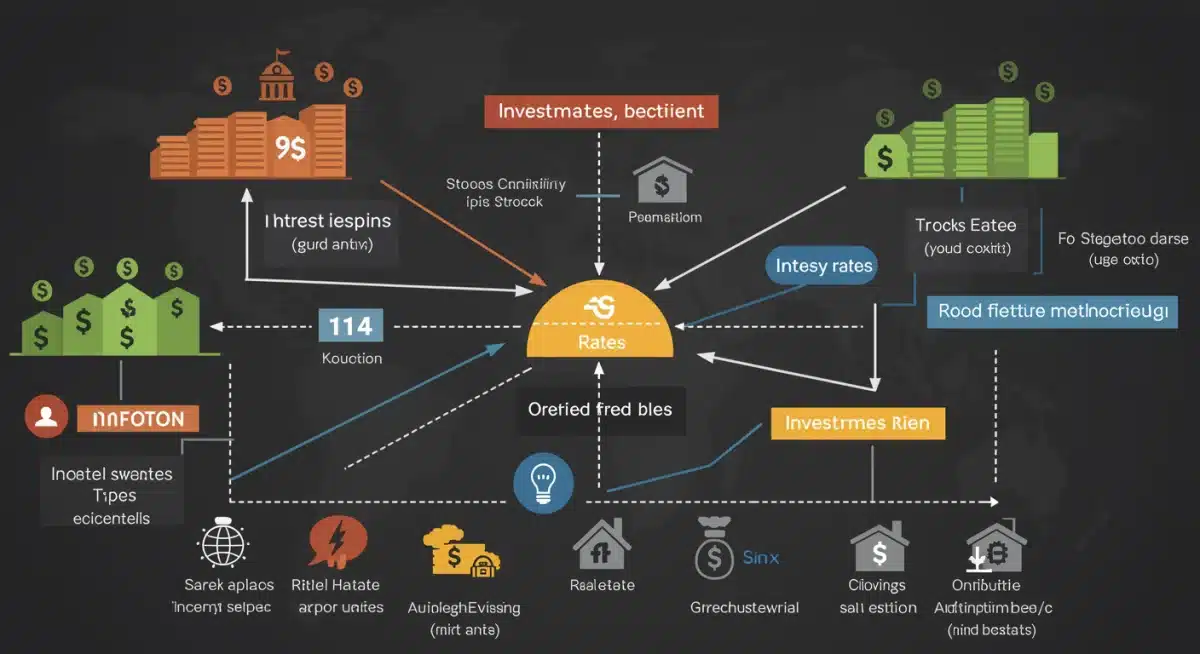
Growth stocks, which often rely on future earnings and debt-financed expansion, tend to be more sensitive to interest rate fluctuations. Value stocks, often mature companies with stable cash flows, may be more resilient. Sector-specific impacts are also common, with financial institutions often benefiting from higher rates (due to wider net interest margins) and utility companies potentially suffering (as their stable dividends become less attractive compared to rising bond yields).
Sector-Specific Considerations for 2025
- Technology and Growth Stocks: May face headwinds if rates remain high, as their future earnings are discounted more heavily.
- Financials: Could see improved profitability with higher net interest margins, benefiting from a rising rate environment.
- Real Estate: Higher mortgage rates can cool housing demand and impact real estate investment trusts (REITs).
- Consumer Discretionary: Consumer spending, influenced by borrowing costs, directly affects these sectors.
Investor sentiment also plays a significant role. Uncertainty surrounding Fed policy can lead to increased market volatility, while clarity, even if it’s a hawkish stance, can sometimes bring stability. In 2025, investors will need to carefully assess company fundamentals, debt levels, and sector sensitivity to interest rates to make informed decisions and potentially rebalance their portfolios.
Ultimately, the stock market is a forward-looking mechanism. Investors try to anticipate the Fed’s moves and their economic consequences. Therefore, understanding the Fed’s communication and economic outlook is paramount for positioning equity portfolios for success in the evolving rate environment.
Real Estate and Alternative Investments in a Shifting Rate Environment
The real estate market is highly sensitive to interest rate changes, primarily through their impact on mortgage rates and borrowing costs. When the Federal Reserve’s interest rate decisions lead to higher mortgage rates, the cost of homeownership increases, which can cool demand, reduce affordability, and potentially lead to a slowdown in housing price appreciation or even declines.
For real estate investors, higher borrowing costs can reduce the profitability of new projects and increase the carrying costs of existing properties. This applies to both residential and commercial real estate. However, specific segments of the market might react differently; for instance, rental demand could increase if homeownership becomes less accessible.
Real Estate Considerations for 2025
- Residential Real Estate: Higher mortgage rates may continue to dampen sales volume, but supply constraints could provide some support for prices in certain markets.
- Commercial Real Estate: Office, retail, and industrial sectors will be influenced by economic growth, remote work trends, and financing costs.
- REITs (Real Estate Investment Trusts): These publicly traded entities can offer liquidity and diversification but are also sensitive to interest rate changes and broader economic conditions.
Beyond traditional real estate, alternative investments such as commodities, private equity, and cryptocurrencies also react to interest rate environments, albeit through different channels. Commodities, for example, can act as an inflation hedge, potentially performing well if inflation persists even with higher rates. Private equity and venture capital, which rely heavily on debt financing, may face challenges in a high-rate environment due to increased borrowing costs and tighter lending conditions.
Cryptocurrencies, while often seen as uncorrelated, can still be influenced by global liquidity conditions and risk appetite, both of which are shaped by central bank policies. A tighter monetary policy typically reduces overall liquidity, which can put downward pressure on riskier assets, including digital currencies.
For investors looking at 2025, diversification into alternative assets can offer potential benefits, but careful due diligence is required. Understanding how each alternative asset class performs under various interest rate scenarios is crucial for integrating them effectively into a diversified portfolio strategy.
Crafting Your Investment Strategy for 2025
Navigating the investment landscape in 2025, shaped by the Federal Reserve’s interest rate decisions, requires a thoughtful and adaptable strategy. The key is to avoid panic and make informed choices based on your personal financial goals, risk tolerance, and time horizon. A proactive approach to portfolio management can help mitigate risks and capitalize on emerging opportunities.
One of the foundational principles in an uncertain interest rate environment is diversification. Spreading investments across various asset classes, sectors, and geographies can help cushion the impact of adverse movements in any single area. This includes a balanced mix of stocks, bonds, real estate, and potentially alternative investments, tailored to your individual profile.
Strategic Adjustments for a Dynamic Market
- Rebalance Your Portfolio: Regularly review and adjust your asset allocation to align with your risk tolerance and market conditions.
- Focus on Quality: Prioritize companies with strong balance sheets, consistent earnings, and competitive advantages, as they tend to be more resilient during economic shifts.
- Consider Shorter-Duration Bonds: In a rising rate environment, shorter-duration bonds offer less interest rate risk and more frequent opportunities to reinvest at higher yields.
- Explore Dividend-Paying Stocks: Companies that consistently pay dividends can provide a source of income, potentially offsetting some market volatility.
Furthermore, maintaining a healthy cash reserve is prudent. This not only provides a buffer against unexpected expenses but also positions you to take advantage of investment opportunities that may arise during market downturns. With potentially higher yields on savings accounts and money market funds, cash can also offer a decent return in a high-rate environment.
It is also vital to stay informed about economic data releases and the Federal Reserve’s communications. While predicting the Fed’s exact moves is challenging, understanding their outlook and the factors influencing their decisions can provide valuable insights for your investment planning. Consulting with a financial advisor can also provide personalized guidance, helping you to tailor your strategy to the evolving economic climate and your specific financial situation.
The Broader Economic Implications of Fed Policy
Beyond direct market impacts, the Federal Reserve’s interest rate decisions have profound broader economic implications that affect businesses, consumers, and the overall trajectory of the U.S. economy. These decisions are not made in a vacuum; they reflect the Fed’s assessment of current conditions and its forward-looking view on inflation and employment.
When the Fed raises interest rates, it generally aims to slow down an overheating economy and curb inflation. This makes borrowing more expensive for businesses, potentially leading to reduced investment, slower job growth, and tighter credit conditions. For consumers, higher rates mean more expensive mortgages, car loans, and credit card debt, which can dampen spending and contribute to a slowdown in economic activity.
Macroeconomic Effects to Monitor in 2025
Several key macroeconomic effects will be influenced by Fed policy in 2025:
- Inflation: The primary target of recent Fed tightening. The success in bringing inflation down to target will dictate future rate movements.
- Employment: The Fed balances inflation control with maintaining maximum employment. A significant weakening of the labor market could prompt a shift in policy.
- Economic Growth (GDP): Tight monetary policy can slow economic growth. The risk of a recession is often a concern when rates are elevated.
- U.S. Dollar Strength: Higher U.S. interest rates can attract foreign capital, strengthening the dollar, which impacts trade and international investments.
Conversely, if the Fed begins to cut rates, it typically signals an intention to stimulate economic growth. Lower borrowing costs encourage businesses to invest and expand, and consumers to spend, potentially leading to increased job creation and a boost in overall economic activity. However, too much stimulus can risk reigniting inflationary pressures.
The Fed’s balancing act between controlling inflation and supporting employment is delicate. Their policy choices in 2025 will be critical in determining whether the U.S. economy achieves a soft landing, enters a recession, or continues to battle persistent inflation. Understanding these broader implications helps investors contextualize market movements and make more informed long-term decisions about their portfolios.
The global economy also plays a role, with international events and the actions of other central banks influencing the Fed’s considerations. This interconnectedness means that no economic forecast, especially concerning interest rates, can be made without acknowledging the wider global financial landscape.
| Key Aspect | Impact on Investments |
|---|---|
| Fixed Income | Higher rates decrease existing bond values but offer better yields on new issues. |
| Stock Market | Increased borrowing costs for companies, potentially slowing growth and impacting valuations. |
| Real Estate | Higher mortgage rates can cool housing demand and increase investor borrowing costs. |
| Overall Strategy | Requires diversification, quality focus, and active portfolio rebalancing. |
Frequently Asked Questions About Fed Rates and Investments
When the Federal Reserve raises its benchmark interest rate, banks typically follow suit by increasing the interest rates they offer on savings accounts, CDs, and money market accounts. This means your savings can earn more, making these conservative options more attractive for holding cash.
Not necessarily. While higher rates can create headwinds for the stock market by increasing borrowing costs for companies and making fixed income more appealing, a crash is not guaranteed. The market’s reaction depends on the pace of rate hikes, economic growth, and corporate earnings. Often, a gradual increase is absorbed.
While forecasts vary, many analysts anticipate a period of stabilization, potentially followed by modest rate reductions if inflation continues to cool without a significant economic downturn. However, the outlook is data-dependent and subject to change based on economic indicators and global events.
To protect your bond portfolio, consider strategies like investing in shorter-duration bonds, which are less sensitive to rate changes. You can also use a bond ladder strategy or explore inflation-protected securities (TIPS). Diversification across different types of fixed income can also mitigate risk.
It’s generally not advisable to make drastic changes based on every single Fed announcement. Instead, focus on your long-term financial goals and risk tolerance. Use Fed communications as a guide to understand the broader economic environment and make strategic adjustments to your diversified portfolio over time.
Conclusion
The Federal Reserve’s interest rate decisions are a dominant force shaping the financial landscape, and their impact on your investments in 2025 cannot be overstated. From the yields on your savings to the performance of stocks, bonds, and real estate, every corner of your portfolio feels the ripple effect of monetary policy. Understanding the Fed’s mandate, its tools, and the broader economic implications of its actions is paramount for making informed investment choices. As we move through 2025, a proactive, diversified, and adaptable investment strategy, coupled with a keen eye on economic data, will be essential for navigating potential volatilities and capitalizing on emerging opportunities in this dynamic environment.