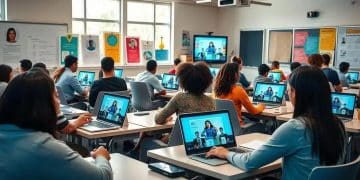
AI’s Impact on US Education: Tools & Teaching for 2025

Artificial intelligence is profoundly influencing US education by introducing advanced tools and necessitating new teaching methods, aiming to create more dynamic and personalized learning environments for 2025 classrooms.
The landscape of learning in the United States is undergoing a profound transformation, largely driven by the rapid advancements in artificial intelligence. This technological wave is not merely a fleeting trend but a fundamental shift that is redefining how students learn and how educators teach. The Impact of AI on US Education: New Tools and Teaching Methods for 2025 Classrooms is already palpable, promising a future where education is more personalized, efficient, and engaging than ever before.
The evolving role of AI in personalized learning
Artificial intelligence is revolutionizing education by enabling highly personalized learning experiences, a stark contrast to traditional one-size-fits-all approaches. AI-powered platforms can assess individual student needs, learning styles, and paces, then adapt content and delivery accordingly. This level of customization ensures that each student receives targeted support and challenges, maximizing their potential.
For instance, intelligent tutoring systems leverage AI to provide instant feedback and explanations, simulating a one-on-one tutor experience. These systems can identify knowledge gaps and recommend specific resources or exercises, allowing students to master concepts before moving on. This adaptive learning environment fosters deeper understanding and greater student autonomy.
Adaptive learning platforms and their benefits
Adaptive learning platforms are at the forefront of AI integration in education. They continuously analyze student performance data to adjust the difficulty and type of material presented.
- Tailored content delivery: Ensures students receive material best suited to their current understanding.
- Real-time feedback: Provides immediate insights into performance, aiding quick correction and comprehension.
- Identification of learning gaps: Pinpoints specific areas where students struggle, allowing for targeted intervention.
- Increased engagement: Keeps students motivated by offering appropriately challenging tasks.
AI for differentiated instruction
AI tools empower teachers to implement differentiated instruction more effectively. By automating the assessment and recommendation process, AI frees up educators to focus on higher-level teaching strategies and individual student support, rather than spending excessive time on administrative tasks.
The ability of AI to process vast amounts of data quickly means that teachers can gain comprehensive insights into their classroom’s collective and individual learning patterns. This data-driven approach allows for more informed pedagogical decisions, leading to more effective teaching strategies and improved student outcomes. The promise of personalized learning, once a distant ideal, is now a tangible reality thanks to AI.
New AI tools for educators and administrators
Beyond direct student interaction, AI offers a plethora of tools designed to streamline administrative tasks and enhance instructional planning for educators. These innovations aim to reduce teachers’ workload, allowing them more time to focus on direct student engagement and professional development. From grading to curriculum design, AI is becoming an indispensable partner in the educational ecosystem.
Administrative functions, often a burden on school staff, are also being optimized by AI. This includes tasks such as scheduling, resource allocation, and even predicting student performance trends, which can help in proactive intervention strategies. The goal is to create a more efficient and responsive educational institution.
Automated grading and feedback systems
One of the most time-consuming tasks for educators is grading. AI-powered systems can now automate the grading of various assignments, from multiple-choice tests to essays, providing consistent and unbiased feedback.
- Efficiency: Significantly reduces the time spent on grading.
- Consistency: Ensures uniform grading standards across all submissions.
- Detailed feedback: Offers specific suggestions for improvement, not just a score.
- Bias reduction: Minimizes human biases in evaluation.
AI in curriculum development and resource management
AI can assist in designing curricula by analyzing learning objectives and suggesting relevant resources. It can also manage educational resources, ensuring that materials are up-to-date and accessible to both teachers and students. This ensures that the learning content remains current and engaging.
Furthermore, AI can help identify educational trends and predict future skill requirements, enabling curriculum developers to prepare students for the demands of the 21st-century workforce. This forward-looking approach is crucial for maintaining the relevance and quality of education in a rapidly changing world. AI’s utility in supporting educators and administrators is rapidly expanding, promising a more efficient and effective educational system.
Transforming teaching methods for 2025 classrooms
The integration of AI into education necessitates a significant evolution in teaching methods. Educators are moving away from traditional lecture-based models towards more facilitative and collaborative approaches. The role of the teacher is shifting from a sole dispenser of knowledge to a guide, mentor, and facilitator of learning experiences, leveraging AI as a powerful assistant.
This transformation requires teachers to develop new competencies, including technological literacy and the ability to critically evaluate and integrate AI tools into their pedagogical practices. Professional development programs are crucial to equip educators with the skills needed to thrive in AI-augmented classrooms.


Project-based learning and AI collaboration
AI tools can enhance project-based learning by providing resources, facilitating research, and even offering virtual collaboration spaces. Students can use AI to gather information, analyze data, and generate creative solutions, fostering critical thinking and problem-solving skills.
- Enhanced research capabilities: AI can quickly find and synthesize relevant information for projects.
- Virtual collaboration: AI-powered platforms enable seamless teamwork among students, regardless of location.
- Creative problem-solving: Students can use AI to explore diverse solutions and scenarios.
- Skill development: Encourages critical thinking, collaboration, and digital literacy.
Flipped classrooms and AI-driven content
The flipped classroom model, where students learn new content at home and apply it in class, is greatly supported by AI. AI can deliver engaging and adaptive content for home study, allowing classroom time to be dedicated to discussion, problem-solving, and personalized teacher interaction.
This method maximizes the value of in-person class time, transforming it into a dynamic workshop environment where teachers can provide targeted support and address student difficulties in real-time. The pedagogical shifts driven by AI are creating more dynamic, student-centered learning environments that empower both educators and learners.
Addressing ethical considerations and challenges
While the benefits of AI in education are substantial, its implementation also raises critical ethical considerations and challenges that must be addressed. Issues such as data privacy, algorithmic bias, and the digital divide require careful navigation to ensure equitable and responsible integration of AI technologies.
Stakeholders, including educators, policymakers, parents, and students, must engage in open dialogue to establish clear guidelines and best practices for AI use in educational settings. Proactive measures are essential to mitigate potential risks and harness AI’s full potential ethically.
Data privacy and security concerns
AI systems often rely on vast amounts of student data, raising significant privacy and security questions. Protecting sensitive information from misuse or breaches is paramount.
- Anonymization of data: Implementing techniques to remove personally identifiable information.
- Robust security protocols: Ensuring data storage and transmission are protected against cyber threats.
- Transparent data policies: Clearly communicating how student data is collected, used, and stored.
- Compliance with regulations: Adhering to educational data privacy laws such as FERPA.
Algorithmic bias and equity
AI algorithms are only as unbiased as the data they are trained on. If training data reflects existing societal biases, AI tools can perpetuate or even amplify these inequalities, leading to unfair outcomes for certain student populations.
Ensuring equity in AI implementation also means addressing the digital divide. Not all students have equal access to technology or reliable internet, which could exacerbate existing educational disparities if AI tools are not thoughtfully integrated. Developers and educators must work collaboratively to create AI solutions that are fair, transparent, and accessible to all students, regardless of their background or socioeconomic status. Addressing these challenges head-on is crucial for the ethical and effective deployment of AI in education.
Preparing students for an AI-driven future
The pervasive presence of AI in future workplaces means that preparing students for an AI-driven future is no longer optional but a fundamental responsibility of the education system. This involves not only teaching students how to use AI tools but also fostering critical thinking, ethical reasoning, and adaptability – skills that complement, rather than compete with, AI capabilities.
Curricula must evolve to include digital literacy, computational thinking, and an understanding of AI principles. The aim is to empower students to become creators and innovators in an AI-powered world, not just passive consumers of technology.
Developing AI literacy and critical thinking
Students need to understand how AI works, its capabilities, and its limitations. This includes developing the ability to critically evaluate information generated by AI and to understand its ethical implications.
- Understanding AI concepts: Learning the basics of machine learning and algorithms.
- Ethical AI use: Debating the societal and moral impact of AI technologies.
- Data interpretation: Critically analyzing data and insights provided by AI.
- Problem-solving with AI: Using AI as a tool to solve complex problems.
Fostering human-centric skills
In an AI-augmented world, skills that are uniquely human – creativity, emotional intelligence, collaboration, and complex communication – will become even more valuable. Education must prioritize the development of these soft skills.
By focusing on projects that require innovative thought, teamwork, and empathetic understanding, educators can ensure students develop a well-rounded skill set that positions them for success in any future career path. The goal is to cultivate individuals who can effectively collaborate with AI, leveraging its strengths while bringing uniquely human insights and capabilities to the table. This holistic approach ensures students are not only technologically proficient but also well-equipped to navigate the complexities of an AI-integrated society.
The future outlook: AI in US education by 2025
As we approach 2025, the integration of AI into US education is poised for accelerated growth and deeper sophistication. The initial phases of AI adoption have laid the groundwork, and the coming years will likely see more widespread and nuanced applications, moving beyond novelty to become an integral part of daily educational practice. This future outlook anticipates a more symbiotic relationship between human educators and intelligent systems, leading to unprecedented educational outcomes.
The continuous evolution of AI technology, coupled with ongoing research in learning sciences, will undoubtedly lead to even more innovative tools and teaching methodologies. The focus will remain on enhancing learning efficacy, promoting equity, and preparing students for a future that is increasingly shaped by artificial intelligence.
Predictive analytics for student success
AI will increasingly be used for predictive analytics, identifying students at risk of falling behind or disengaging, allowing for early intervention and personalized support strategies. This proactive approach can significantly improve retention rates and academic achievement.
- Early identification of at-risk students: Proactive intervention before academic issues escalate.
- Personalized support plans: Tailored strategies for students needing extra help.
- Resource optimization: Efficient allocation of educational resources where they are most needed.
- Improved graduation rates: Contributing to better overall student success.
Virtual reality and augmented reality with AI
The convergence of AI with virtual reality (VR) and augmented reality (AR) promises immersive learning experiences that were once unimaginable. AI can power intelligent tutors within VR environments or provide context-aware information in AR settings, making learning more interactive and experiential.
These technologies can transport students to historical events, simulate complex scientific experiments, or allow them to explore anatomical structures in 3D, all guided by intelligent AI. This fusion of AI with immersive technologies will undoubtedly redefine engagement and depth of understanding in 2025 classrooms and beyond, making learning an adventure rather than a chore. The future of US education with AI is bright, promising a more inclusive, effective, and exciting learning journey for all.
| Key Aspect | Brief Description |
|---|---|
| Personalized Learning | AI tailors educational content and pace to individual student needs and learning styles. |
| New Teaching Methods | Shift to facilitative roles, project-based learning, and flipped classrooms enhanced by AI tools. |
| Ethical Considerations | Addressing data privacy, algorithmic bias, and equitable access to AI technologies. |
| Future Skills Development | Fostering AI literacy, critical thinking, creativity, and human-centric skills for an AI-driven world. |
Frequently asked questions about AI in US education
AI personalizes learning by analyzing individual student data, including learning styles, pace, and performance. It then adapts educational content, exercises, and feedback to match each student’s specific needs, ensuring a tailored and effective learning path that optimizes comprehension and engagement.
Educators can leverage AI for automated grading and feedback systems to save time, AI-powered platforms for curriculum development and resource management, and predictive analytics to identify at-risk students. These tools streamline administrative tasks and enhance instructional planning, allowing teachers to focus more on direct student interaction.
AI is transforming traditional teaching into more facilitative and collaborative approaches. Methods like project-based learning benefit from AI for research and collaboration, while flipped classrooms use AI for delivering engaging content at home, dedicating class time to active problem-solving and deeper discussions.
Key ethical concerns include data privacy and security, ensuring student information is protected. Algorithmic bias is another major issue, as AI systems can perpetuate inequalities if not carefully designed. Addressing the digital divide to ensure equitable access to AI tools is also crucial for fair implementation.
AI prepares students by fostering AI literacy and critical thinking, teaching them to understand and ethically use AI tools. It also emphasizes human-centric skills like creativity, collaboration, and emotional intelligence, which are increasingly valuable in an AI-driven world, equipping students to thrive alongside technology.
Conclusion
The integration of AI into US education is not merely an enhancement but a fundamental reshaping of how learning is conceived and delivered. For 2025 classrooms, AI promises a future where education is more personalized, efficient, and deeply engaging, preparing students with the skills necessary for an evolving world. While challenges related to ethics and equity remain, proactive engagement and thoughtful implementation will ensure AI serves as a powerful catalyst for positive educational transformation, fostering a generation that is not only technologically adept but also critically aware and socially responsible.